
01What happened on 13 April 2026
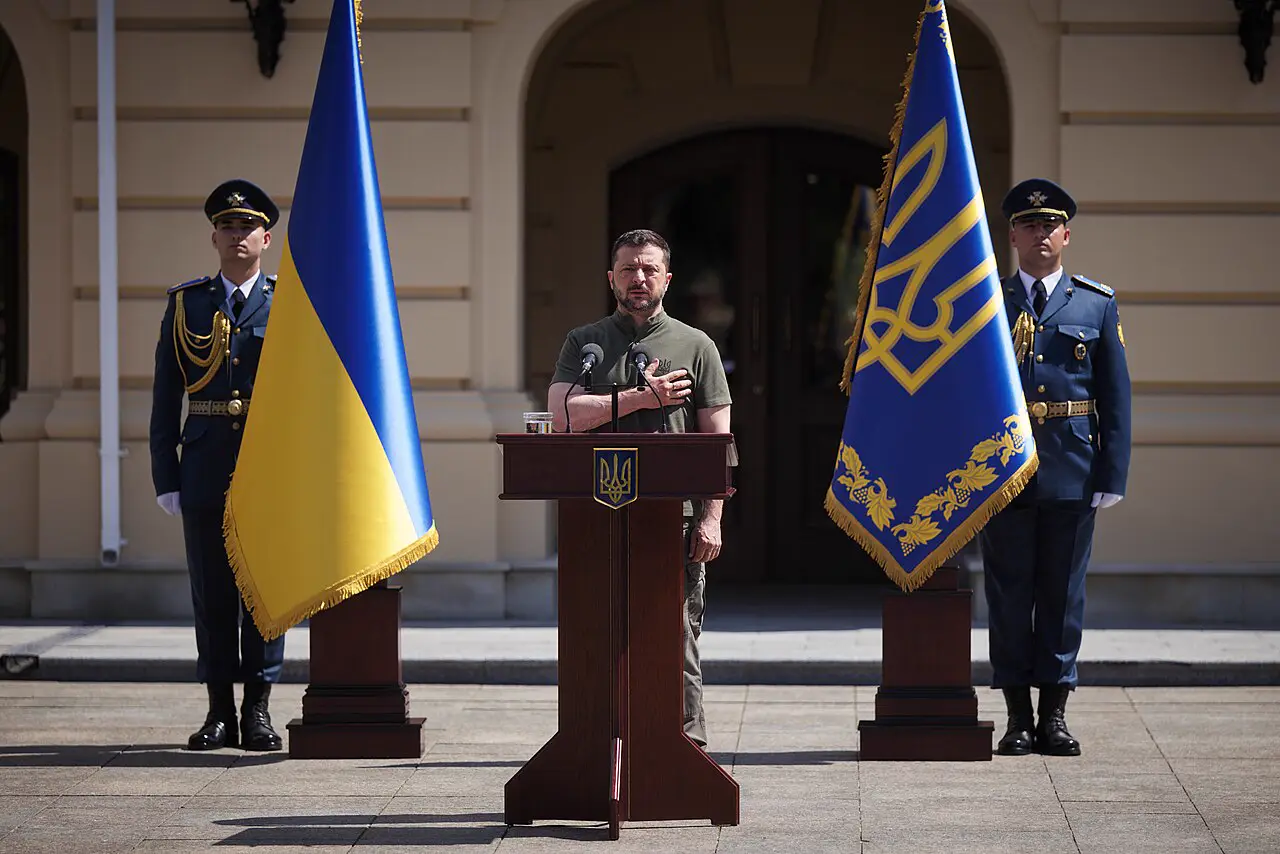
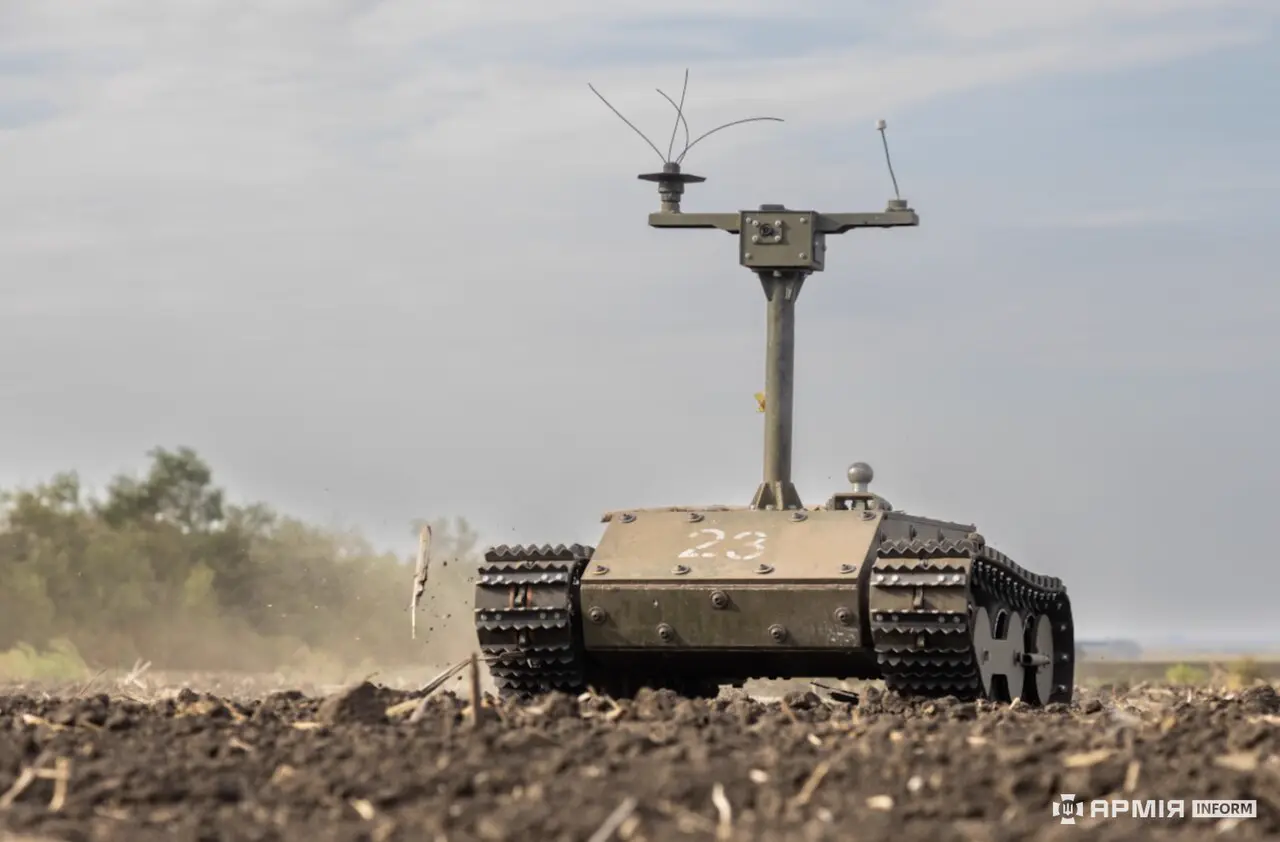
Ukrainian President Volodymyr Zelensky announced the operation in a short statement: a Russian frontline position had been taken without infantry and without losses on the Ukrainian side. The assault was carried out entirely by unmanned systems: ground robots and drones.
No precise location has been given. All public reports are based on Ukrainian military communications; no independent journalist witnessed it. Video footage shows a destroyed position and Russian soldiers surrendering. No independent body has verified the footage so far.
Context
Despite the limited verification, militarily the operation is regarded as a historic milestone, because it shows for the first time that UGVsUGVUnmanned ground vehicle. Remote-controlled or partly autonomous, similar to drones but on the ground. can carry out assault missions successfully, not just logistics and reconnaissance.
13 April is the best-documented case so far of a development that has been under way for months. In the first quarter of 2026 the Ukrainian army carried out more than 22,000 frontline operations with ground robots, over 9,000 of them in March alone, 50 per cent more than the month before. The number of units actively using ground robots rose from 67 in November 2025 to 167 in spring 2026.[1]
There had already been another precedent on 28 January 2026: near Lyman, a Ukrainian combat robot of the type DevDroid Droid TW-7.62 took three Russian soldiers prisoner. It was the first time in this war that a robot system took prisoners.[8]
▶ 02 · The systems02The seven systems and what ground robots can do today
Seven different Ukrainian systems were used in the assault on 13 April. Most are remote-controlled vehicles with a camera and weapons, and their AI share is growing.[2, 3]
Behind these systems is a growing Ukrainian defence industry: more than 40 companies and over 200 different models. The manufacturer Tencore alone delivered more than 2,000 vehicles in 2025 and plans to produce 40,000 units in 2026, 10 to 15 per cent of them armed. By April 2025 NATO had already codified 55 Ukrainian ground robots to its standards.[1, 3]
▶ 03 · Autonomy03The autonomy question: human or machine?
According to Ukraine's official line, every decision to open fire requires human approval. This is called human-in-the-loopHuman-in-the-loopThe principle that a human must actively confirm every important decision of an AI system before it is carried out. Regarded as the minimum safety standard for AI in critical areas.. The CSISCSISCenter for Strategic and International Studies, an influential US think tank on security and defence policy in Washington, D.C. confirms that human oversight remains central, especially for decisions to fire.[2]
Technically, AI already takes over some functions today without humans approving each step:
- Target recognition: AI identifies targets at a range of 1 to 2 km; the limit used to be 300 m.
- Drone hit rate: with AI support it is 70 to 80 per cent, compared with 10 to 20 per cent without.
- Autonomous navigation: if communications fail, many systems keep navigating on their own.
- The "Fourth Law" module: an AI add-on costing 50 to 100 US dollars that guides a drone autonomously to a pre-set target if communications are lost.
The CSIS warns explicitly that the label "human-in-the-loop" is an aspiration, not a technically binding guarantee. The line is shifting systematically from active human control to supervision, from being in the loop to being an observer. The ICRCICRCInternational Committee of the Red Cross. The leading humanitarian organisation and guardian of international humanitarian law (IHL). draws the line at who selects the target. A system that decides for itself what to attack after losing its connection falls under the definition. A system that independently flies to a target chosen by a human does not.
Supervision instead of control
Human-in-the-loop is a statement of intent. There is no technical standard of that name. If a system acts autonomously when communications fail, the human is outside the loop. What an operator approves instead today is explained in our article on an area, a time window and an effect.
The Rys system is a good example of this shift. According to reports, its AI makes targeting decisions that used to require human judgement in fractions of a second, under fire, far faster than a human can react. Whether a human is still "in the loop" or merely standing beside it can hardly be told apart technically.[2, 4] What it means when AI systems make their own decisions and slip out of human control is covered in our article on AI agents and autonomy.
▶ 04 · The legal vacuum04The legal vacuum: no law for killer robots
Not a single international agreement regulates autonomous weapons systems in a binding way. While civilian AI is regulated at least in the EU by the AI Act, there is not even a binding framework for military systems, as our article on the Pentagon-OpenAI deal shows.
IHLIHLInternational humanitarian law. It governs how wars may be fought in order to protect civilians and prisoners. Its basis is the Geneva Conventions of 1949. prohibits systems that cannot distinguish between civilians and combatants. Four basic principles are affected: distinction, proportionality, precaution and accountability. The last is the hardest. If an AI makes a wrong decision and kills civilians, who is liable? The operator, the programmer, the manufacturer, or the commander who ordered the deployment? International humanitarian law gives no binding answer.
The Lieber Institute at the West Point Military Academy calls this the "accountability gap": the more intermediate steps an AI takes over itself, the harder it becomes to assign human responsibility in concrete terms.[4]
What the United Nations is doing, and what it is not
In December 2024 the UN General Assembly voted by 166 to 3 for a resolution calling for informal consultations on LAWSLAWSLethal autonomous weapons systems. The official UN term for weapons that can select and attack targets without a human decision in each individual case.. There was no mandate for treaty negotiations, because the US opposed it.[9]
In February 2026 the REAIM summit took place in A Coruña, Spain. Of 85 participating countries, only 35 signed a non-binding declaration. The US and China refused to sign.[14] Stop Killer Robots, a campaign of more than 200 NGOs in 60 countries, said that unregulated military AI in Gaza and Ukraine shows the danger of non-binding guidelines.[10] Only three months earlier the UN General Assembly had voted again, by 156 to 5 and in sharper terms, for a binding treaty mandate. That decision also had no effect, because the US and Russia blocked any binding implementation.
| When | Event | Outcome |
|---|---|---|
| 2014 to today | GGE LAWS: UN negotiating group meets under the CCW | No binding outcome; US, Russia and China block |
| Dec. 2024 | UN General Assembly: resolution for informal consultations on LAWS | 166 to 3 votes, no treaty mandate |
| Sept. 2025 | GGE session: joint statement by 42 states calls for a mandate to codify | No outcome; blocked by the major powers |
| Nov. 2025 | UN General Assembly: another vote, worded more sharply | 156 to 5; the US and Russia block implementation |
| Feb. 2026 | REAIM summit, A Coruña: 85 participating countries | 35 signatories; the US and China refuse to sign |
Germany and France are calling for a ban on fully autonomous weapons. Russia and Israel, together with the US, block any binding instrument. The UN negotiating group GGE LAWSGGE LAWSGroup of Governmental Experts on Lethal Autonomous Weapons Systems, the UN expert group negotiating on autonomous weapons since 2014. It meets under the CCW (Convention on Certain Conventional Weapons). has been meeting since 2014. It has not yet produced a binding result.[11]
▶ 05 · Biometrics05Biometrics on the battlefield
Autonomous combat robots need image recognition. The recognition systems in this war also collect data away from the front, at checkpoints for example.
Clearview AI, the US company that built a database of 100 billion facial images by mass-scraping public photos, has been used by more than 1,500 Ukrainian officials since March 2022. According to the company, as reported by Reuters and TIME, more than 230,000 biometric identifications of Russian individuals have been carried out at checkpoints.
Ukraine's AI battlefield management system DELTA goes further. Using neural networks, it recognises 70 per cent of unique enemy equipment units in an average of 2.2 seconds.[2] In March 2026 Ukraine opened its battlefield AI data to Western allies and defence companies for the first time: millions of annotated images from tens of thousands of missions are now available as training material.[13]
What this means
The Ukrainian battlefield is the world's largest training ground for military AI systems. The data collected there will shape the next generation of weapons systems, which will then be used in other conflicts, including by companies such as OpenAI, which has been working openly with the US military since 2026 (→ Pentagon & OpenAI: when AI wages war). How AI-assisted target recognition works on the US side is shown by Palantir's Maven Smart System (→ Palantir: the quiet defence contractor).
In a report of April 2025, Human Rights Watch documented a weakness of biometric AI recognition systems: an error rate of more than 34 per cent for dark-skinned women. In a weapons system that makes decisions based on this recognition, that could have fatal consequences for civilians. On top of the unresolved question of liability comes algorithmic discrimination.[5]
[Warning] Human Rights Watch, April 2025: biometric AI systems have an error rate of more than 34 per cent for dark-skinned women. In a weapons system that makes targeting decisions on the basis of this recognition, that error rate puts civilians at risk.
06What this means for everyone
Russia is developing its own UGVUGVUnmanned ground vehicle. Remote-controlled or partly autonomous, similar to drones but driving on the ground., the "Kuryer", with an autonomous 82 mm mortar module that can reload in five seconds; it is still in testing. On the demilitarised zoneDMZDemilitarised zone: the 4 km wide buffer strip between North and South Korea, one of the most heavily fortified border areas in the world since the 1953 armistice., South Korea is testing AI-assisted sentry systems that are technically able to fire autonomously, with formal human approval. Japan is investing 640 million US dollars in autonomous coastal defence. Australia plans 12 to 15 billion Australian dollars over the next decade.[3]
The war in Ukraine is therefore the case study on which all other countries are basing their own programmes. Not every observer shares the optimism: military analyst Hendrik Remmel told ZDF that ground robots are not a game changer, because in urban terrain and under electronic warfare they are far more vulnerable than infantry.[12] Ukrainian units also report heavy losses among the vehicles, especially in difficult terrain and under heavy Russian drone fire.[3]
Three open questions
Who is liable? If an AI ground robot kills civilians because it cannot reliably tell combatants from civilians, there is no binding legal basis that determines who is criminally responsible. The OECD AI Incident Monitor has already classified Ukrainian AI weapons systems as an official "AI incident" with harm that has actually occurred.[7]
Where is the line? In practice, the distinction between remote-controlled and autonomous is blurring. A system that keeps driving and firing on its own when communications fail meets the technical definition of an autonomous weapon, whatever the official doctrine says.
Whose AI learns what? The millions of data records from Ukrainian combat operations now available to Western defence companies will train future weapons systems. There is no binding answer to the question of which ethical and legal limits apply.