

- 01The misconception: "Messages disappear, don't they?"
- 02Snap Map: Your child's real-time location
- 03My AI: The chatbot that stores everything
- 04What Snapchat collects about your child
- 05Snapchat compared: better than TikTok, worse than WhatsApp
- 06What parents can do right now
- 07How teenagers bypass the safeguards
- 08Tracking and advertising: the invisible ecosystem
- 09Data protection incidents: what has happened so far
- 10Snapchat: the full comparison
- 11What really disappears — and what doesn't
The misconception: "Messages disappear, don't they?"
That is the core problem with Snapchat. The idea that everything disappears creates a sense of safety — one that does not reflect reality. Yes, Snaps are deleted after being viewed. But a complete data profile runs in the background: location, facial geometry, chat histories with the AI, usage behaviour, installed apps on the device.
For parents, this is crucial to understand: Snapchat is no less data-intensive than Instagram or TikTok — it just looks that way.
Snap Map: Your child's real-time location
Snap Map is the most dangerous feature for young people. Outdoors, the accuracy is a few metres — the specific building is identifiable. Anyone monitoring the map over time can determine a child's home address, school location, daily routine and regular routes.
The BBC has identified Snapchat as the most frequently used social media app for online groomingGroomingThe deliberate initiation of sexual abuse against minors. Perpetrators systematically build trust online in order to manipulate and exploit children. in the UK. NSPCC expert Rani Govender stated: "The problem lies in the design and functionality of the app." Internet-ABC, SCHAU HIN! and SaferInternet.at all agree: children and teenagers should not use Snap Map under any circumstances.
My AI: The chatbot that stores everything
Since April 2023, My AI — a chatbot based on OpenAI's GPT — has been available to all Snapchat users, pinned permanently at the top of the chat list. Without any option to remove it unless you pay for Snapchat+. The user rating in the App Store subsequently dropped to 1.67 stars.
The problem for parents: all conversations with My AI are stored until the user manually deletes them — a fundamental breach of the promise of disappearing content. This data feeds into advertising and AI training. Anyone chatting about recipes will see cooking adverts. Anyone writing about school stress is giving Snapchat an insight into their child's emotional world.
What Snapchat collects about your child
The privacy policy (as of April 2025) lists extensive categories: precise GPS location data (also via Wi-Fi and mobile masts), biometric facial geometryBiometricA unique mapping of your face — the distance between your eyes, the shape of your nose, your jawline. This data is like a fingerprint: it identifies you individually and cannot be changed. from Lenses and filters (stored for up to 3 years), a list of all installed apps on the device, communication patterns (who, when, how often), search histories and advertising interactions.
Particularly sensitive: with permission granted, Snapchat reads the entire address book. Even if the permission is later revoked, the contacts already transferred are not automatically deleted — they must be removed manually in the app settings.
Snapchat compared: better than TikTok, worse than WhatsApp
| Criterion | Snapchat | TikTok | ||
|---|---|---|---|---|
| Real-time location | Snap Map (metres) | Approximate | Approximate | No |
| Biometric data | Facial geometry | Face + voice | AR filtersAR FiltersAugmented Reality filters — digital effects overlaid in real time on your face (animal ears, make-up, age filters). The app must map your face to do this. | Minimal |
| GDPRGDPRGeneral Data Protection Regulation — the EU's data protection law since 2018. Violations can be fined up to 4% of global annual turnover. fines | None | €345 million | €405 million | €225 million |
| Default DMs under 18 | Friends only | Friends only (<16) | Followers | Anyone with number |
| Parental controls | Family Center | Family Pairing | Supervision | None |
| Message encryption | No | No | No | End-to-endEnd-to-end encryptionThe most secure form of communication: only sender and recipient can read the message. Neither the provider nor hackers can intercept it. WhatsApp has this; Snapchat does not. |
What parents can do right now
How teenagers bypass the safeguards
Tracking and advertising: the invisible ecosystem

Snapchat's advertising infrastructure is designed to collect data even when users reject tracking. The central tool is the Snap PixelSnap PixelAn invisible tracking code that advertisers embed on their websites. It tracks what you do after clicking on a Snapchat ad — which pages you visit, what you buy. — a JavaScript code that advertisers embed on their websites. It tracks what users do after clicking on a Snap ad: page views, registrations, purchases. Ad blockers prevent the Pixel for 25–30% of users.
Snap's response: the Conversions API (CAPI)CAPIA server-to-server connection that completely bypasses ad blockers and cookie restrictions. Snapchat uses this to track even users who actively resist tracking. — a server-to-server connection that completely bypasses browser blockers. CAPI integrations grew by around 300% in the first quarter of 2024 compared to the previous year. Advertisers using CAPI see up to 19% more attributed purchases and ~50% more app installs on iOS.
Since Apple's App Tracking Transparency (ATT)ATTApple's privacy feature since iOS 14.5: apps must ask for permission before tracking you across other apps and websites. Around 75% of users decline., around 75% of iOS users reject app tracking. Snap's response was to develop Advanced ConversionsAdvanced ConversionsSnapchat's ad attribution system that works even when users decline tracking. Uses statistical models on aggregated data instead of individual user tracking. — a system using modelled attribution rather than user-based tracking. Snap continues to process aggregated data for these users and makes clear that information "may be linked for advertising purposes in ways where we do not specifically identify you and your activities". The French non-profit Exodus Privacy found tracker signatures from Mapbox (location telemetry) and AppsFlyer (mobile attribution) when analysing the Snapchat APK — indicating their presence in the code.
Data protection incidents: what has happened so far
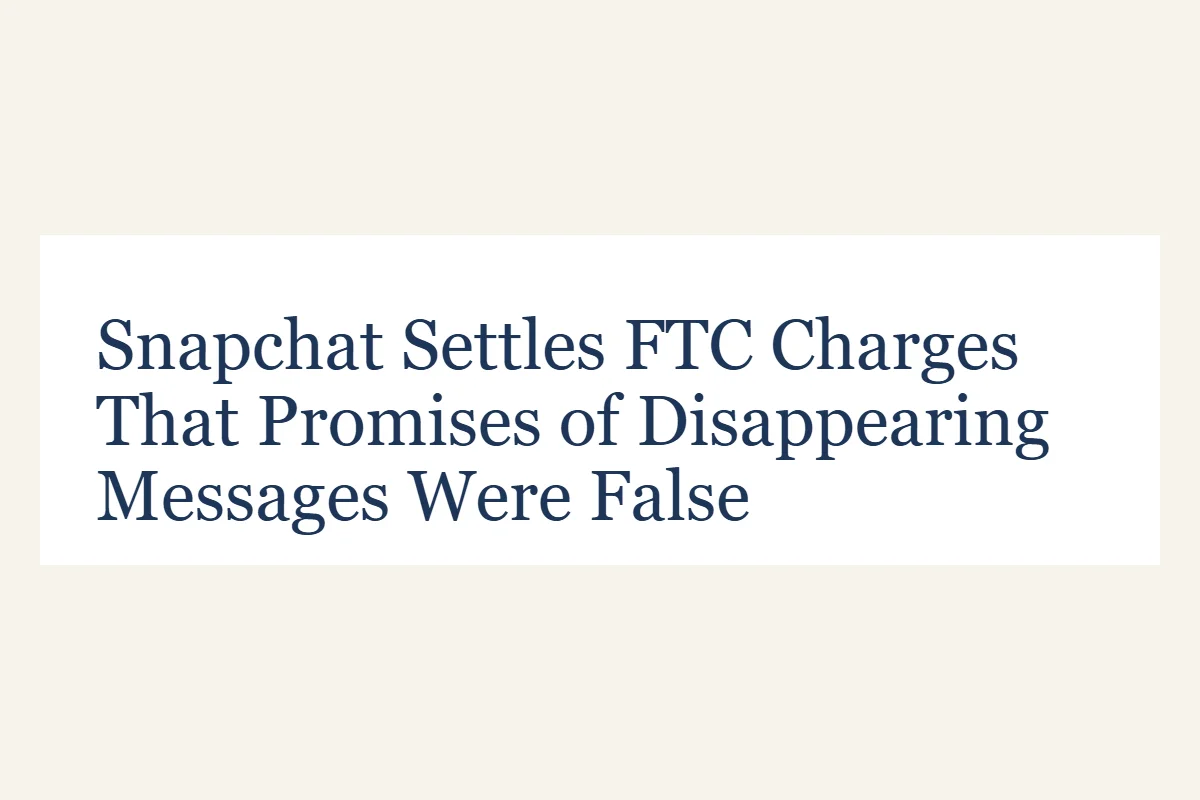
Snapchat's history contains several serious incidents that illustrate how significant its data protection shortcomings are:
Snapchat: the full comparison
The independent data-protection ranking by Incogni (2024) placed Snapchat second among the least invasive platforms — ahead of Instagram, TikTok and Facebook. In the 2025 ranking, Snapchat dropped due to AI data usage, but remained better than Meta products and TikTok.
| Criterion | Snapchat | TikTok | ||
|---|---|---|---|---|
| Third-party trackers | 3–4 per session | 14 per session | 5–6 per session | 2–3 per session |
| Cross-platform tracking | No | Limited | Yes (Meta) | Yes (Meta metadata) |
| Biometric data | Facial geometry | Face + voice | AR filters | Minimal |
| GDPRGDPRGeneral Data Protection Regulation — the EU's data protection law since 2018. Violations can be fined up to 4% of global annual turnover. fines | None | €345 million | €405 million | €225 million |
| Data after deletion | 60 days | 30 days | 180 days | 90 days |
| Default DMs under 18 | Friends only (fixed) | Friends only (<16) | Followers | Anyone with number |
| Ad opt-out | Yes (3 options) | Limited | Yes (Meta) | Limited |
| Parental controls | Family Center | Family Pairing | Supervision | None |
| Ad-free option | Snapchat+ Platinum | No | Meta subscription (EU) | No |
TikTok's unique risk: keystroke logging via the in-app browser (demonstrated by security researcher Felix Krause), explicit facial and voice prints, data sharing with ByteDance in China. Meta's risk: cross-platform aggregation across Facebook, Instagram, WhatsApp and Messenger — the greatest profiling potential of all. Snapchat's unique risk: Snap Map — but this can be largely neutralised through Ghost Mode and device settings.
What really disappears — and what doesn't
To clarify for conversations with your child: sent Snaps are deleted within 24 hours of being opened. Stories disappear after 24 hours of visibility. But: metadataMetadataData about data: not the content of a message, but who wrote to whom, when, and how often. From this, relationships, daily routines and contact networks can be reconstructed. (who wrote to whom, when) is retained for ~30 days. My AI conversations are stored permanently. Biometric facial data from Lenses for up to 3 years. Marketing analytics data for up to 13 months.
And the most important point: any screenshot someone else takes is permanent. Snapchat does send a notification — but the image is gone.